CLAUDE API · AGENTS · PYTHON · Cork AI Consulting
Assessment EngineAI Opportunity Assessment Engine
Cork AI Consulting sells one entry product: a paid AI Opportunity Assessment that finds where a business loses time and money and prices the fix. Writing each report by hand was slow and its quality depended on the writer. I built the engine that drafts it from the call itself, and a gate that refuses to let it overclaim.
- Live delivered to the first client before launch
- Transcript → report one pipeline, client-branded output
- Honesty gate unsupported claims are blocked, not softened
- Value ROI-backed Every opportunity priced
- Time Agent-drafted Report drafting
- Effort Co-founder build Built in-house
- Quality 0 Unsupported claims shipped
- Step 01 Extract before writing
- Step 02 Size opportunities conservatively
- Gate An honesty gate with teeth
- Step 04 Client-branded, human-reviewed
- Output ROI-backed Every opportunity priced
01 — Context
The problem.
A good assessment needs two things that pull against each other: it has to be specific enough that the owner recognises their own business, and conservative enough that every number survives a sceptical accountant.
Written by hand, reports were slow and their quality depended on who wrote them. Written naively by an LLM, they read well and invent savings. Neither is acceptable for a product whose whole promise is honesty.
02 — Method
The approach.
The build, in the order it happened.
-
Extract before writing
The transcript is first turned into structured facts — processes, volumes, hours, tools, pain points — each tied to the line it came from. Nothing downstream is allowed to use a fact without that citation.
-
Size opportunities conservatively
Each candidate automation is priced from the client’s own stated volumes and a deliberately conservative hourly cost, so the headline number is a floor rather than a pitch.
-
An honesty gate with teeth
A separate check reads the draft against the extracted facts and blocks any claim that has no source. Failing claims are removed or sent back for a human decision — never quietly reworded.
-
Client-branded, human-reviewed
The report renders in the client’s colours and logo, and a consultant reviews it before it is sent. The agent does the drafting; a person signs it.
- Sources Claude APIClaude CodePython
- Step 01 Extract before writing
- Step 02 Size opportunities conservatively
- Gate An honesty gate with teeth
- Step 04 Client-branded, human-reviewed
- Output ROI-backed Every opportunity priced
03 — A run
What one run looks like.
The steps above, played as the agent would walk them. A reading of the write-up, not a recording of a real run.
run assessment-engine
[plan] 4 steps
[step 01] Extract before writing
↳ The transcript is first turned into structured facts
[step 02] Size opportunities conservatively
↳ Each candidate automation is priced from the client’s own stated volume…
[gate] ✓ An honesty gate with teeth
↳ A separate check reads the draft against the extracted facts and blocks…
[step 04] Client-branded, human-reviewed
↳ The report renders in the client’s colours and logo, and a consultant r…
[tools] Claude API · Claude Code · Python · Structured outputs · HTML/PDF rendering · Git
[handoff] First assessment delivered to a client in August 2026, ahead of the company’s September l…
[exit 0]
04 — Outcome
What changed.
- First assessment delivered to a client in August 2026, ahead of the company’s September launch.
- Report drafting moved from a manual write-up to an agent run plus a human review.
- Every figure in a delivered report can be traced back to something the client actually said.
05 — Screens
What it looks like.
Generated from the write-up rather than captured from a client's screen — the shape of the thing, not a leaked one.
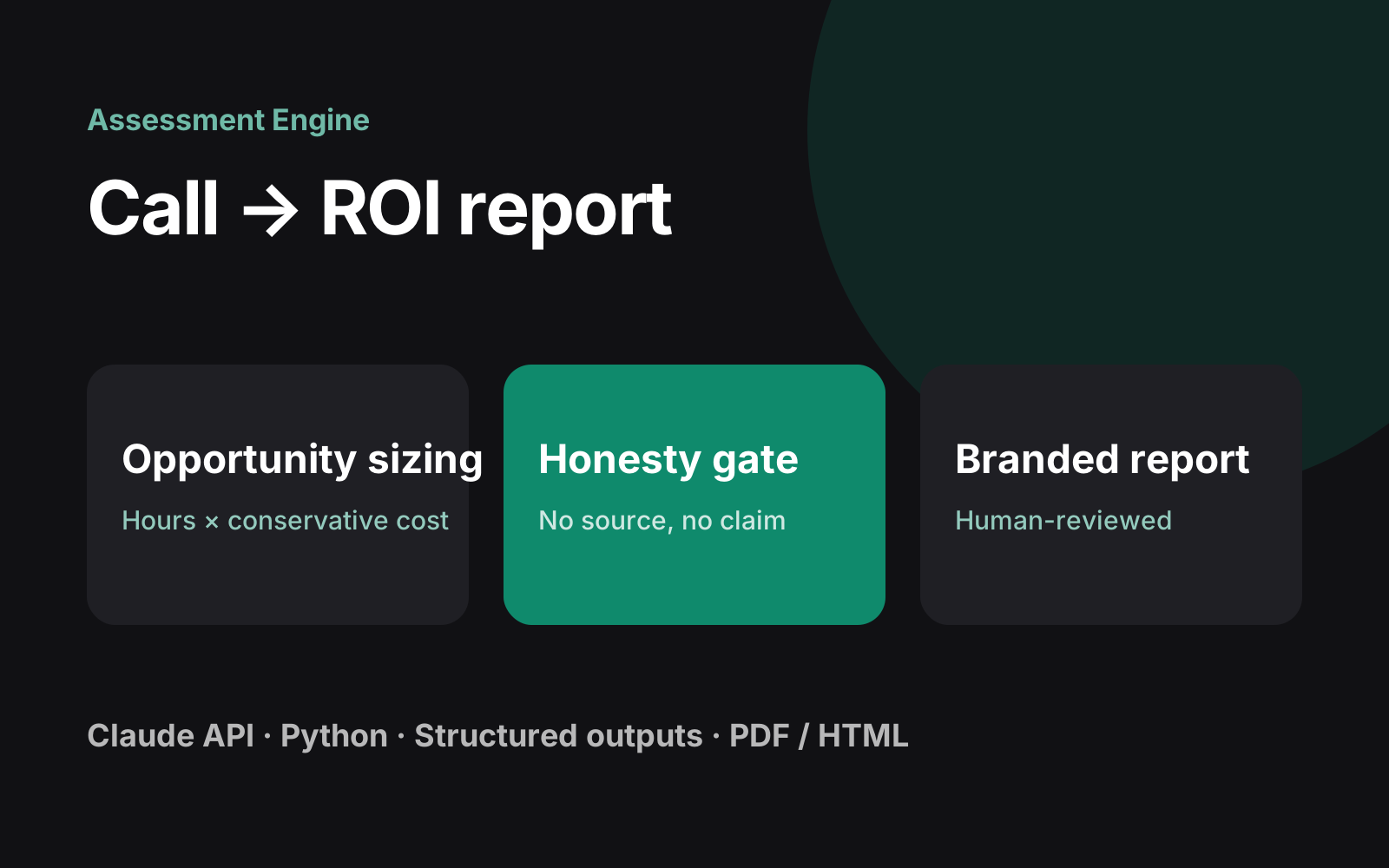
An agent that turns a discovery-call transcript into a client-branded, ROI-backed report — with an honesty check that blocks any claim the call didn’t support.
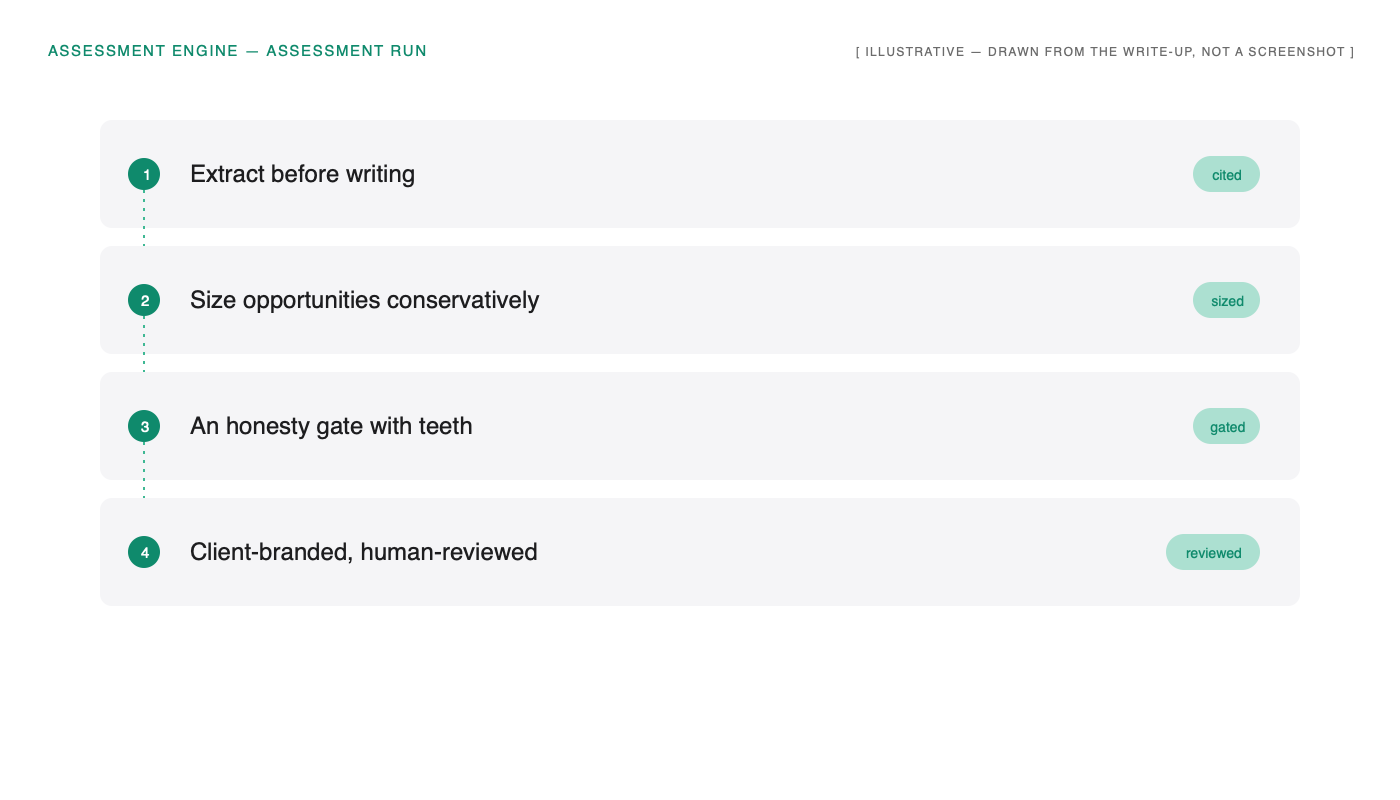
The four steps as a pipeline: extract before writing, size conservatively, the honesty gate, client-branded and human-reviewed.
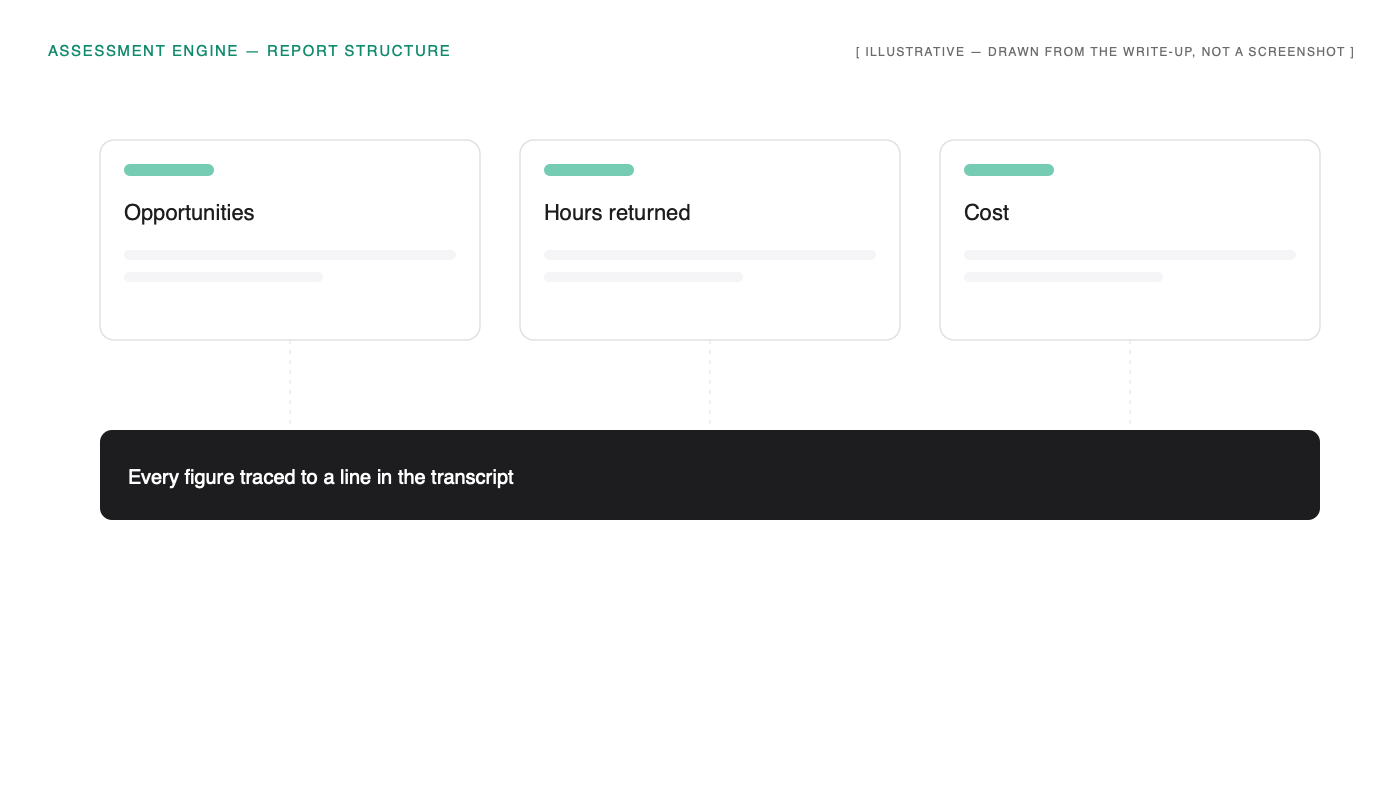
The shape of a report: opportunities, hours returned and cost, each traced to a line in the transcript.
06 — Stack & role
Built with.
- Claude API
- Claude Code
- Python
- Structured outputs
- HTML/PDF rendering
- Git
- Role
- Co-founder — design and build
- Duration
- Summer 2026, in production since August
- Client
- Cork AI Consulting
- Period
- 2026
07 — Questions
The questions I get asked about this one.
Because it will. Fluent, specific and wrong is the worst possible output for an ROI document. Separating extraction, sizing and checking is what makes the output defensible.
Transcripts are processed for that client’s report only and are not reused across clients.